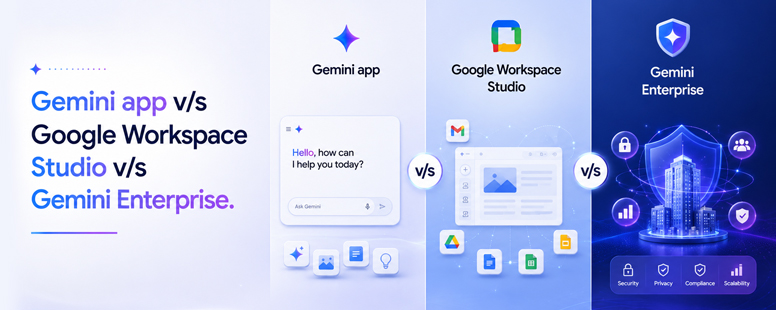
Breaking down: Gemini app v/s Google Workspace Studio v/s Gemini Enterprise
In 2026, the question is no longer “should we use AI?” but “which AI architecture serves our specific mission?” Google has streamlined its ecosystem into three distinct tiers, each serving a different layer of the organization. Understanding the difference between these paths is the key to maximizing your ROI and securing your data.
To help you decide, let’s look at your AI options through the lens of a growing digital workforce.
1. The Gemini App: Your Digital “Freelancer”
Focus: Individual Productivity & Creativity
The Gemini app is the portal for high-speed assistance. It is designed for the individual who needs a creative spark or a rapid researcher at their fingertips.
- How it Works: It retrieves data from your personal extensions—searching your specific Gmail, Drive, and Chat history to answer personal queries.
- The Unique Edge (Nano Banana 2): This tier features the latest visual engine, allowing users to generate 2K/4K images with “Subject Consistency.” You can maintain the exact likeness of a character or product across an entire storyboard.
- The Example: A marketing lead needs to draft a campaign brief. Gemini pulls the latest notes from their Gmail, finds the budget sheet in Drive, and generates a set of consistent visual mockups for the first draft.
2. Google Workspace Studio: The “Automation Bot”
Focus: Workflow Automation & Process Efficiency
Workspace Studio is a no-code workbench designed for the specialized foreman. It doesn’t just suggest ideas; it moves data to get a job done.
- How it Works: It operates on strict, script-based logic. You define a trigger and an action (If-This-Then-That) to connect Google to third-party tools like Slack and Salesforce.
- The Workflow: It performs transactional tasks perfectly, but it lacks “reasoning.” It only knows the specific steps you have programmed into its flow.
- The Example: A Sales Operations manager builds a “Task Agent.” Trigger: A new lead is tagged in Salesforce. Action: The bot automatically summarizes the lead’s history in a Google Doc and pings the regional head on Slack.
3. Gemini Enterprise: Your AI “Chief of Staff”
Focus: Strategic Intelligence & Organizational Grounding
Gemini Enterprise is an agentic platform built for autonomous reasoning. This is the highest tier, designed for organizations that need a “brain” capable of solving complex problems without a pre-written script.
- How it Works: It uses Grounding. Unlike the other tiers, it securely indexes your organization’s entire history across Slack, Salesforce, SAP, and SharePoint to create a private Knowledge Base.
- The Advantage (Business Agents): You give it a goal, not a manual. It plans its own research steps across different data silos to find an answer.
- The Example: You ask the agent, “Audit our Q1 spending against vendor approvals in Slack and the contracts in our CRM.” The agent autonomously decides to check the invoices, cross-reference them with chat approvals, and find discrepancies without you defining a single “If/Then” rule.
The Strategic Comparison: At a Glance
| Capability | Gemini App | Workspace Studio | Gemini Enterprise |
| Logic Type | Ad-hoc Assistance | Rule-Based: Follows a “Flow” | Reasoning-Based: Solves Goals |
| Data Scope | Personal Context | Task-Specific Data | Full Grounding: Org History |
| Connectivity | Personal Google Apps | Webhooks & Connectors | Deep, Native Ecosystem Sync |
| Governance | Personal security | Team-level permissions | Centralized IT Control |
Which AI tier aligns with your specific security needs and growth goals?
Choosing between these three architectures is a foundational decision that impacts your organization’s long-term efficiency. If you are struggling to map these tiers to your specific business problems—whether it’s auditing complex budgets, managing high-volume CRM leads, or automating cross-platform notifications—we are here to provide the clarity you need.