
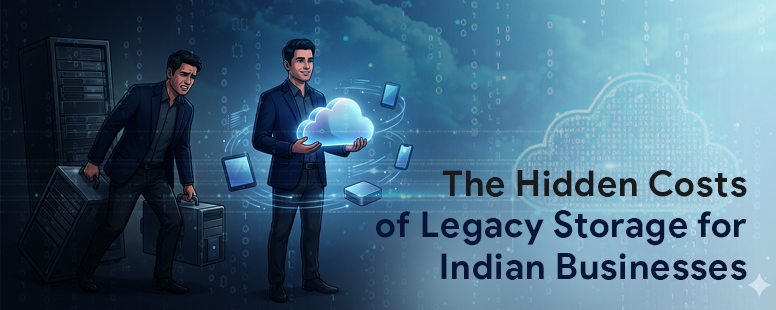
Legacy Storage vs Cloud Storage: The Real Cost for Indian SMBs
The legacy storage vs cloud storage debate is no longer just a tech conversation for Indian businesses. It is a business survival question. Hard drive failure rates hit 1.42% annually in 2025, with some models failing at nearly 9.5%. When that drive goes, so does everything on it.
If your data strategy still relies on physical hardware, this blog is for you.
What Is Legacy Storage?
Legacy storage means keeping your data on physical hardware inside your office or data centre. This includes hard drives, tape drives, NAS boxes, and on-premise servers. Your IT team manages everything from backups to maintenance to recovery. When hardware fails, the responsibility falls entirely on them.
Most Indian SMBs built their storage infrastructure this way. It felt secure because the data was physically nearby. But proximity is not the same as protection.
What Is Cloud Storage?
Cloud storage moves your data to remote servers managed by a third-party provider. Services like Google Drive, part of Google Workspace, store and protect your data across multiple geographically distributed locations. You pay a subscription fee and skip the hardware management entirely.
Your team accesses files from any device, from anywhere in the world. All they need is an internet connection.
Legacy Storage vs Cloud Storage: A Real Comparison
Cost
When you stack legacy storage vs cloud storage on cost alone, the gap is wider than most finance teams expect. Legacy storage comes with hidden costs that add up fast. Hardware procurement, annual maintenance contracts, electricity, cooling, and dedicated IT time all hit the budget. A single drive failure brings an unplanned capital expense with no warning.
Cloud storage is predictable month to month. There is no infrastructure to maintain and no surprise replacement costs to budget for.
Security
Physical storage gives you control over hardware, but also full responsibility for it. A fire, flood, power surge, or theft can wipe out years of data in one incident. Most Indian SMBs simply do not have the budget to run enterprise-grade security on their own infrastructure.
Cloud providers build multiple security layers from the start: encryption in transit and at rest, multi-factor authentication, admin access controls, and detailed audit logs. Shivaami, as a Google Cloud Security Specialization partner, helps businesses configure these controls correctly from day one.
For a deeper look at how Google protects business data, read: How Secure is Google Drive for Your Business Files?
📊 Did You Know? India saw 41% year-on-year growth in cloud adoption in 2025, one of the highest rates globally. Indian businesses are clearly voting with their budgets.
Access and Collaboration
Legacy storage is locked to a location. Remote access usually means a slow VPN that someone on your team has to set up and maintain. That is friction nobody needs every morning.
Cloud storage works from any device, in any city. Your team in Mumbai and a colleague in Surat can open and edit the same file simultaneously. No lag, no version conflicts, no IT ticket.
Scalability
Running out of storage on-premises means raising a purchase order and waiting for delivery. Installation and reconfiguration can take weeks before you can store a single extra file.
Cloud storage scales in minutes. Upgrade your plan, and the capacity is live immediately. No hardware decisions, no downtime, no procurement delays.
Disaster Recovery
Most SMBs store their backup device in the same room as their primary server. One incident takes both down simultaneously. Organisations without a tested disaster recovery plan face recovery costs more than twice as high as those who plan.
Cloud infrastructure distributes your data across multiple servers and locations automatically. Recovery is built into the architecture, not added as an afterthought. Shivaami’s Google Cloud Platform services include disaster recovery planning as part of every deployment.
The Hidden Problem: IT Dependency
Legacy storage creates single points of human failure. If the person managing your backups is on leave, your data strategy is at risk. In lean Indian SMB IT teams, this is a very common and very real problem.
Cloud storage removes that dependency entirely. Admin controls, user permissions, and audit logs live in a central dashboard. No tribal knowledge required. Shivaami’s Managed Services team can also handle ongoing cloud management, allowing your internal team to focus on growth.
What About DPDP Compliance?
India’s Digital Personal Data Protection Act is now in effect. It places clear obligations on businesses around how they collect, store, and protect user data. When comparing legacy storage vs cloud storage through a compliance lens, the difference is stark. Legacy storage, with its manual access controls and inconsistent backup practices, makes compliance harder to demonstrate and audit.
Business cloud storage through Google Workspace gives admins full visibility into data access and sharing activity. Data region controls let you choose where your data is stored. For regulated industries, auditability matters significantly.
Is Cloud Storage Right for Every Indian Business?
For most, yes. The one real variable is internet reliability. In areas with inconsistent connectivity, offline sync keeps your team working. Files update automatically once the connection is restored.
For businesses with very specific on-premise compliance needs, a hybrid approach works well. Reduce your legacy footprint where it makes sense and move collaboration data to the cloud first. Shivaami’s Infrastructure Modernization team specialises in exactly this kind of phased transition.
How Indian SMBs Can Start Moving Away from Legacy Storage
Start with a storage audit. Understand how much data you have, who accesses it, and what would happen if it disappeared tomorrow. That exercise alone tends to make the migration decision very clear.
From there, move collaboration and shared files first, then email data, then archival storage. Each phase reduces your legacy storage risk without disrupting daily operations.
If you want support planning that migration, Shivaami helps Indian businesses move to Google Workspace without disruption or guesswork. Talk to our team to plan your migration today.